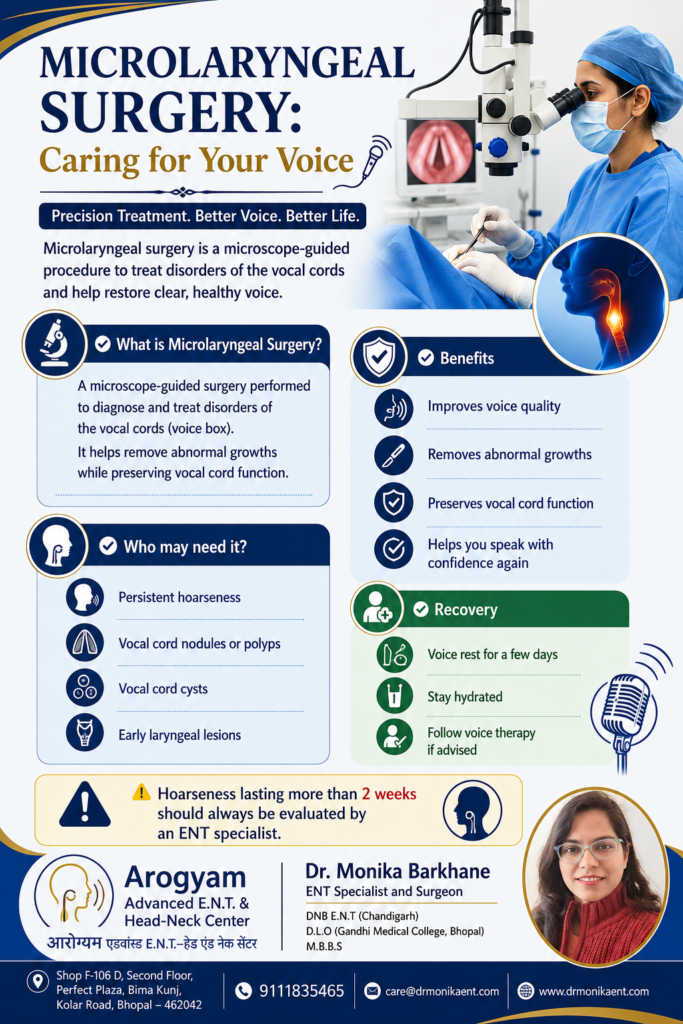
Microlaryngeal Surgery: Caring for Your Voice 🎤
Your voice is an important part of communication, work, and everyday life. When persistent hoarseness, vocal cord lesions, or other problems affect the voice, appropriate evaluation by an ENT specialist is essential. In selected patients, microlaryngeal surgery (MLS) may be recommended to diagnose and treat abnormalities of the vocal cords while preserving as much normal vocal cord tissue and function as possible.
What Is Microlaryngeal Surgery?
Microlaryngeal surgery is a specialized procedure performed to treat conditions affecting the vocal cords and larynx. The surgeon uses a microscope or high-magnification visualization system to obtain a detailed view of the vocal cords and precisely remove or treat abnormal tissue.
The vocal cords are delicate structures. Even a small lesion can alter their vibration and lead to changes in voice quality. The goal of microlaryngeal surgery is therefore not simply to remove a lesion, but to do so with careful preservation of healthy vocal cord tissue.
The procedure is generally performed under general anesthesia. A specialized instrument is introduced through the mouth to reach the larynx, avoiding an external neck incision in most cases. Depending on the condition, the surgeon may remove a polyp, cyst, nodule, or other lesion, or obtain tissue for laboratory examination.
Who May Need Microlaryngeal Surgery?
Not everyone with hoarseness requires surgery. Many voice problems improve with medical treatment, voice therapy, lifestyle modifications, or vocal rest. Surgery is considered when a structural abnormality is present or when another specific indication makes surgical treatment appropriate.
Microlaryngeal surgery may be recommended for conditions such as:
Persistent hoarseness or voice change caused by a structural vocal cord lesion
Vocal cord polyps
Vocal cord cysts
Selected vocal cord nodules that do not respond adequately to conservative management
Certain benign lesions of the vocal cords
Selected early laryngeal lesions
Lesions requiring tissue diagnosis
Other localized abnormalities affecting normal vocal cord vibration
The exact treatment depends on the cause, size, location, and characteristics of the lesion, as well as the patient’s voice requirements.
Why Is Voice Evaluation Important?
Hoarseness is common and may occur after a cold, excessive voice use, or temporary irritation. However, hoarseness that persists for more than two weeks should not be ignored, particularly when there is no obvious temporary cause.
An ENT specialist may examine the larynx using flexible or rigid endoscopy. In some patients, videostroboscopy may also be recommended to assess vocal cord vibration in greater detail.
Early evaluation can help identify benign conditions as well as more serious laryngeal disorders at an earlier stage.
How Is Microlaryngeal Surgery Performed?
Before surgery, the patient undergoes an appropriate ENT and voice assessment. The surgeon determines whether surgery is necessary and discusses the expected benefits, risks, and recovery process.
During the procedure:
The patient is placed under general anesthesia.
A specialized laryngoscope is carefully positioned to provide access to the vocal cords.
The vocal cords are visualized under magnification.
The abnormal lesion is precisely identified.
The lesion is removed or treated using appropriate microsurgical instruments.
Maximum care is taken to preserve healthy vocal cord tissue.
If required, the removed tissue is sent for histopathological examination.
Because the vocal cords are extremely delicate, surgical precision is particularly important. The objective is to restore or improve the vibratory function of the vocal cords while minimizing unnecessary trauma.
What Are the Benefits?
When appropriately indicated, microlaryngeal surgery can provide several benefits:
🎤 Improved Voice Quality
Removing a lesion that interferes with normal vocal cord vibration can improve hoarseness, breathiness, roughness, or other voice changes.
🔬 Precise Treatment
Magnification allows the surgeon to identify and treat small lesions with greater precision.
🛡️ Preservation of Vocal Cord Function
A key principle of microlaryngeal surgery is preservation of healthy tissue. Careful handling of the vocal cords helps protect their ability to vibrate normally.
🧪 Tissue Diagnosis
When appropriate, the removed tissue can be examined under a microscope to establish a definitive diagnosis.
What Can You Expect After Surgery?
Recovery varies depending on the type and extent of surgery and the underlying condition.
Your ENT specialist may recommend a period of voice rest after surgery. The duration can vary, so patients should follow the specific instructions provided by their surgeon.
General recovery measures may include:
Follow the recommended period of voice rest.
Stay adequately hydrated.
Avoid smoking and exposure to tobacco smoke.
Avoid unnecessary throat clearing.
Take prescribed medications as directed.
Avoid excessive shouting, singing, or prolonged speaking until cleared.
Attend follow-up appointments.
Follow voice therapy or speech-language therapy if recommended.
It is important to understand that complete recovery of the voice may take longer than the initial healing of the surgical site. The voice may gradually improve as the vocal cords heal and normal vibration returns.
The Importance of Voice Therapy
In selected patients, surgery is only one part of successful voice rehabilitation. A speech-language pathologist or voice therapist can help patients develop healthier voice-use techniques.
Voice therapy may be particularly useful for people whose work depends heavily on their voice, such as teachers, singers, public speakers, call-center professionals, and healthcare professionals.
Learning appropriate vocal techniques can also help reduce the risk of recurrent voice problems.
Are There Any Risks?
Microlaryngeal surgery is generally performed with the aim of achieving effective treatment while protecting vocal cord function. However, as with any surgical procedure, potential risks exist.
Depending on the procedure and individual circumstances, these may include temporary voice changes, bleeding, infection, dental or lip injury related to instrumentation, scarring, or persistent/recurrent voice symptoms. In some cases, additional treatment may be required.
Your ENT specialist will discuss the expected benefits and potential risks before surgery.
When Should You See an ENT Specialist?
Do not assume that persistent hoarseness is simply a result of overuse.
You should seek an ENT evaluation if you experience:
Hoarseness lasting more than two weeks
Persistent change in voice quality
Difficulty producing your usual voice
Recurrent voice problems
Pain or discomfort associated with voice use
Difficulty swallowing or breathing
A persistent sensation of something in the throat
Other concerning throat or voice symptoms
People who smoke or have other risk factors for laryngeal disease should be particularly attentive to persistent voice changes.
Take Care of Your Voice
Your voice deserves the same attention as any other aspect of your health. Avoid excessive shouting, stay hydrated, use your voice appropriately, and seek professional evaluation when voice changes persist.
Microlaryngeal surgery is a precision-based treatment designed to address selected vocal cord and laryngeal lesions while preserving normal vocal function. Early diagnosis, appropriate surgical technique, postoperative care, and voice rehabilitation can all contribute to the best possible outcome.
If hoarseness persists for more than two weeks, consult an ENT specialist rather than ignoring the symptom. Early evaluation can make an important difference in diagnosis and treatment.
Disclaimer : This blog is for educational purposes only and does not replace professional medical advice. Always consult a qualified healthcare provider for diagnosis and treatment.